


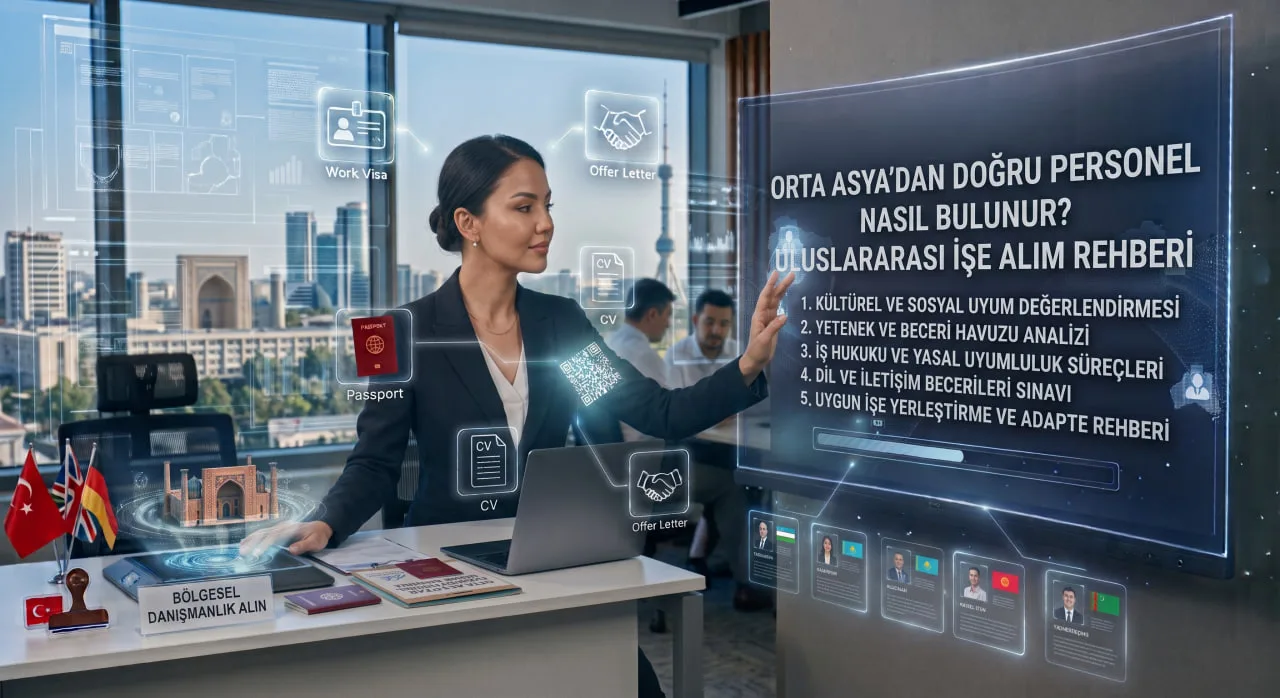
For a business in Türkiye, international recruitment should not be about attracting the largest possible number of applicants. The real objective is to connect the right employee with the right position.
When recruiting candidates from Uzbekistan and other Central Asian countries, employers should look beyond the occupation written on a CV.
Professional experience matters, but so do communication ability, understanding of the position, willingness to accept the actual working conditions and realistic expectations about employment in Türkiye.
This is where ElemanUz's role becomes particularly relevant: helping employers in Türkiye and candidates seeking work opportunities establish a more structured and transparent matching process.
Where should an employer start?
Short answer: define the job before searching for candidates.
A vague personnel request will usually produce a vague candidate pool.
Before recruitment begins, an employer should clearly determine the position, number of employees required, actual responsibilities, mandatory and preferred experience, technical skills, language requirements, location, working hours, shifts, salary and any accommodation or transportation arrangements.
Compare:
“We need 15 production workers.”
with:
“We need 15 employees for a production facility in Türkiye who can work rotating shifts; previous production-line experience is preferred.”
The second description gives both the candidate and the recruiter considerably more useful information.
What should employers evaluate?
A useful international candidate assessment looks at four forms of fit.
Professional fit: Can the candidate actually perform the job?
Communication fit: Can the candidate understand the communication required to perform the work safely?
Working-condition fit: Does the candidate understand and accept the location, shifts and responsibilities?
Expectation fit: Do the candidate's expectations regarding salary, accommodation and the job match what the employer is actually offering?
An attractive CV cannot replace these checks.
Look beyond job titles
Two candidates may both describe themselves as welders, cooks, warehouse workers or production employees while having completely different levels of experience.
Instead of relying solely on a job title, ask candidates to explain what they actually did.
Useful questions include:
“How long did you perform this job?”
“What were your daily responsibilities?”
“Which machines or tools did you use?”
“What did a normal working day look like?”
“Which professional certificates do you hold?”
Specific answers provide much more useful information than a job title alone.
Consider a practical skills check
Depending on the role, a simple skills assessment can be included in the recruitment process.
For a technical position, candidates may be asked to explain equipment they have used, describe how they completed a previous task or explain how they would approach a common workplace situation.
For service roles, scenario-based questions may be more appropriate.
The objective is not to create an unnecessarily difficult examination. It is to determine whether the experience presented by the candidate matches the actual job.
Evaluate language according to the job
Not every role requires advanced Turkish.
A customer-facing employee and a worker carrying out defined tasks on a production line may have very different communication requirements.
The relevant question is:
Can the candidate communicate well enough to perform this particular job safely and effectively?
Rather than relying only on a candidate saying “I speak Turkish,” employers can use a short interview to understand the candidate's actual communication level.
Use video interviews before making a decision
Video interviews are particularly useful when the candidate is still abroad.
Instead of asking candidates simply to repeat their CV, encourage them to describe their real work experience.
Questions such as “Describe a normal day at your previous workplace,” “Which task are you most experienced in?” and “Have you worked shifts before?” can provide a much clearer picture.
The interview is also an opportunity to confirm that the candidate understands the workplace location and the proposed employment conditions.
Make employment conditions transparent
Salary, working hours, shifts, responsibilities, accommodation, meals, transportation and other important terms should be clarified before the candidate travels.
The International Labour Organization's Fair Recruitment principles cover both national and cross-border recruitment and focus on protecting workers throughout recruitment. The International Organization for Migration's IRIS Standard similarly provides an international framework for ethical recruitment involving migrant workers, employers and recruiters.
In practical terms, candidates should not arrive in another country only to discover that the job is substantially different from the one they accepted.
Should workers pay to get a job?
The ILO's definition of recruitment fees recognizes the principle that recruitment fees and related costs should not be charged directly or indirectly to recruited workers or jobseekers. IOM's IRIS framework also promotes the Employer Pays Principle, under which recruitment costs should not be shifted to migrant workers.
Ethical international recruitment therefore should not normalize the idea that a candidate has to pay for access to a job.
This can also help employers build a more trustworthy recruitment chain.
Employers need to provide information too
Recruitment should not be a one-way verification process.
While the employer evaluates the candidate, the candidate should be able to understand:
who the employer is; what the position involves; where the workplace is; the working and shift schedule; offered compensation; accommodation arrangements, if applicable; meal and transportation arrangements; the expected onboarding process.
The ILO's fair recruitment framework is designed in part to help protect workers, including migrant workers, from abusive and fraudulent recruitment and placement practices.
Transparency therefore benefits both sides of the employment relationship.
Do not separate recruitment from legal employment planning
Selecting a candidate does not by itself authorize that person to work in Türkiye.
The candidate's existing status, whether an application will proceed from within Türkiye or abroad and the applicable work permit requirements need to be considered as part of the employment plan.
Foreign work permit applications in Türkiye are administered through the Ministry of Labour and Social Security's e-İzin system.
ElemanUz facilitates employer–candidate matching; the legal right to work and official employment procedures remain subject to the applicable Turkish rules and competent public authorities.
Recruitment does not end when the employee arrives
A successful international recruitment process should include onboarding.
New employees should clearly understand their responsibilities, workplace safety procedures, working hours, supervisor and basic workplace rules.
Employers of foreign workers in Türkiye also remain responsible for applicable social security and notification obligations. Türkiye's Ministry of Labour and Social Security states that these obligations must be completed within the legally prescribed periods.
How does the process work through ElemanUz?
A practical employer journey is:
Define the personnel need → Submit a personnel request → Specify the position and conditions → Review suitable candidates → Interview → Confirm mutual expectations → Complete official employment procedures → Support onboarding
For candidates:
Create a CV → Describe skills and experience → Review suitable opportunities → Meet the employer → Understand employment conditions → Make a decision → Complete the required official process
The objective is not maximum application volume. It is a sustainable match between the employer, the employee and the position.
Frequently Asked Questions How can a Turkish employer find workers from Uzbekistan?
Start with a clear job description and candidate profile. Candidates can then be screened according to experience, skills and working-condition compatibility, followed by interviews and role-appropriate skills verification.
Does a strong CV guarantee a good employee?
No. A CV is useful for initial screening, but actual experience, communication ability, job-specific skills and expectations should also be assessed.
When should salary and accommodation be discussed?
As early as possible. Important employment conditions should be understood before a candidate travels or commits to the position.
Does ElemanUz issue work permits?
No. ElemanUz facilitates candidate–employer matching. Work permit applications and decisions are handled through Türkiye's competent public institutions and the Ministry's e-İzin framework.
Is it better to receive more applications or better-matched applications?
For recruitment quality, the goal should be to identify candidates who genuinely match the position and its working conditions rather than maximizing application volume.
Conclusion
Successful recruitment from Uzbekistan and Central Asia is not primarily about finding more candidates. It is about finding the right candidate for the right job.
A strong international recruitment process combines clear workforce planning, realistic skills assessment, transparent employment conditions, mutual understanding and correct legal onboarding.
Employers can submit their personnel requirements through ElemanUz and begin connecting with candidates from Uzbekistan and Central Asia whose experience and expectations better match their needs.